Key Takeaways
- Fast vs. slow moving averages identify momentum shifts by reacting to price data at different speeds.
- Crossovers act as triggers, signaling potential entries when the fast line crosses the slow line.
- Stop loss placement should be below the recent swing low to protect capital during false signals.
- Strategy works best in trends, often producing false positives in sideways or ranging markets.
- Risk-reward ratio management is crucial; aim for at least 1:2 to offset inevitable losing trades.
What is the Moving Average Crossover Strategy?
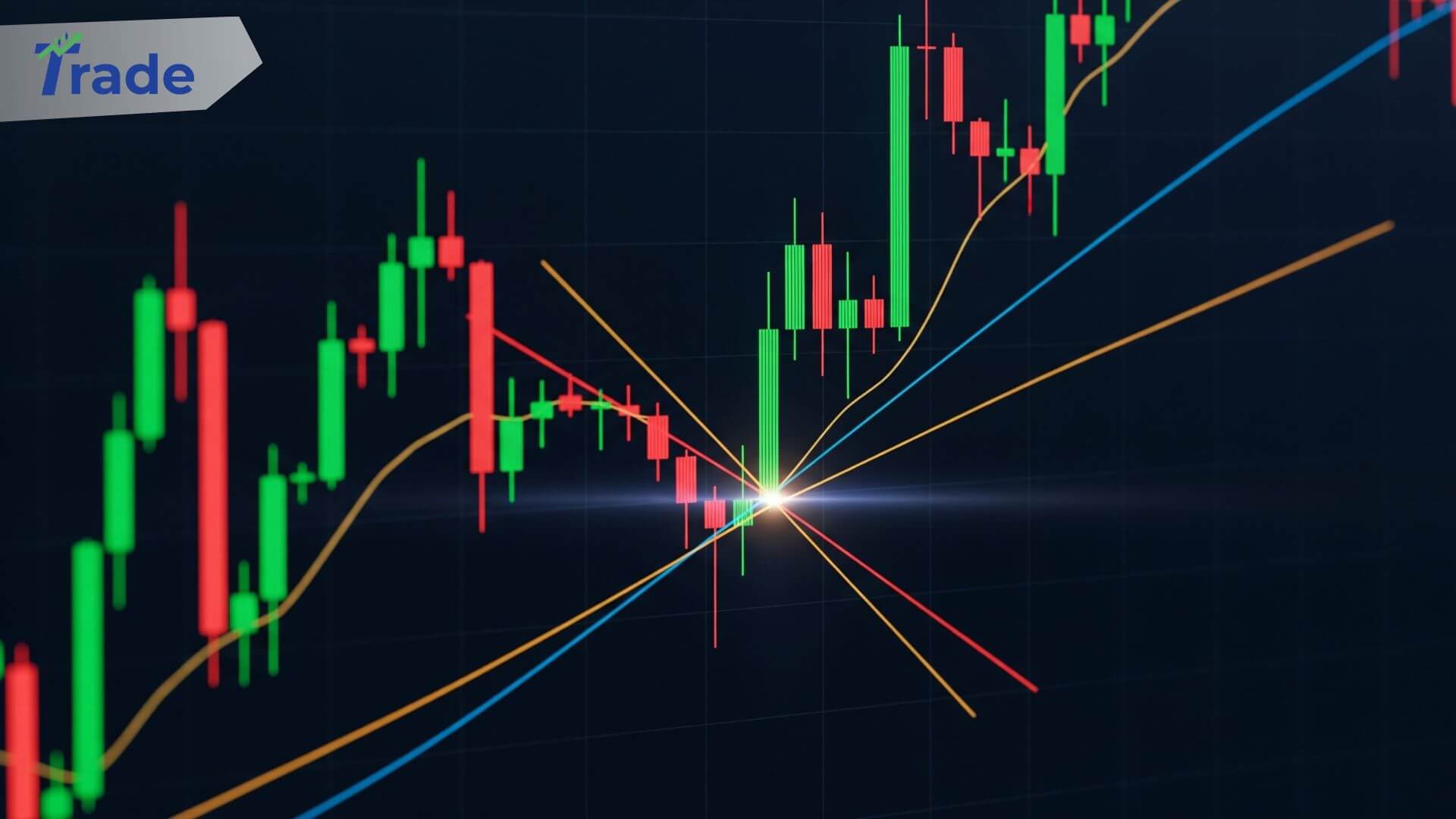
A moving average crossover occurs when a faster-moving average (calculating fewer periods) crosses above or below a slower-moving average (calculating more periods), signaling a potential trend reversal or acceleration. This mechanical signal removes emotional guessing from trading by providing clear buy and sell triggers based on historical price momentum.
Many traders struggle because they try to predict tops and bottoms. This system doesn’t predict; it reacts. By waiting for the lines to cross, you confirm that momentum has actually shifted before you risk your capital.
This guide outlines the exact “recipe” for setting up, entering, and exiting trades using this classic system.
🧾 Strategy Snapshot: Bullish vs. Bearish Setup
| Feature | Bullish Signal (Golden Cross) | Bearish Signal (Death Cross) |
| Trigger | Fast MA crosses ABOVE Slow MA | Fast MA crosses BELOW Slow MA |
| Trend Context | Price is making higher highs | Price is making lower lows |
| Entry Point | Candle close after the cross | Candle close after the cross |
| Stop Loss | Below recent swing low | Above recent swing high |
| Best For | Uptrends & Breakouts | Downtrends & Breakdowns |
Setting Up Your Charts
Selecting the correct periods for your fast vs slow moving average is the foundation of this strategy.
To trade this system, you need two lines on your chart. The “Fast” MA tracks recent price action closely, while the “Slow” MA represents the longer-term trend. A common, effective combination for swing trading is the 9-period (Fast) and the 21-period (Slow).
For this specific setup, you must decide on the type of calculation. If you want faster signals that react quickly to price changes, Exponential Moving Averages (EMAs) are generally superior to Simple Moving Averages (SMAs).
Not sure which type fits your style? Read our guide on SMA vs. EMA indicators to decide which calculation method suits your timeframe.
Once your indicators are applied, visually inspect the chart. If the 9-period line is whippint back and forth over the 21-period line constantly, the market is ranging. This strategy requires clear separation between the lines to function effectively.
Rules for Entry: The Trigger
Definitive trading entry signals occur only when the candle closes, confirming the crossover is valid.
A crossover signal is valid only after the crossover is locked in. During a live trading session, lines may cross and uncross multiple times. You must wait for the candle (time period) to close to confirm the signal.
The Buy Rule (Long):
Enter a long position when the Fast MA (9) crosses above the Slow MA (21). Ideally, the price candle should close bullish (green) near the high of the session.
The Sell Rule (Short):
Enter a short position when the Fast MA (9) crosses below the Slow MA (21). The candle should close bearish (red), indicating strong downward momentum.
Pro Tip: Volume often confirms the move. A crossover accompanied by a spike in volume suggests the trend reversal is supported by institutional money, increasing the probability of a successful trade.
Stop Loss Placement and Risk Management
Protecting your account is more important than the entry; logical stop loss placement prevents catastrophic losses.
New traders often place arbitrary stops. In this strategy, your stop loss must be technical. For a buy signal, place your stop loss just below the most recent swing low (the lowest point before the crossover occurred). For a sell signal, place it above the recent swing high.
This placement allows the trade enough room to “breathe” without cutting you out prematurely due to standard market noise.
Risk Reward Ratio:
Never take a crossover trade if the potential target is closer than your stop loss. Aim for a minimum 1:2 risk reward ratio. If you are risking $50 on the stop loss, your technical target should offer at least $100 in profit. If the chart structure doesn’t allow for this ratio, skip the trade.
Rules for Exit: When to Take Profit
A rigid exit strategy prevents greed from turning a winning trade into a losing one.
There are two primary ways to exit a crossover strategy trade. The first is the Cross-Back method: you stay in the trade until the Fast MA crosses back over the Slow MA in the opposite direction. This allows you to ride massive trends from start to finish. However, in choppy markets, this can give back a lot of profit before the exit signal triggers.
The second method is using fixed targets. You can sell half your position at a 1:2 risk-reward ratio and move your stop loss to breakeven. This secures profit while leaving a portion of the trade open to catch a potential “home run” move.
Conclusion
The moving average crossover is a robust tool because it forces you to trade with the trend rather than against it. While it may lag in fast-moving markets or generate false signals during sideways consolidation, it remains one of the most objective ways to identify trading entry signals.
Success relies on filtering out bad trades (avoiding ranges) and adhering strictly to your risk reward ratio. Start with the 9 and 21 combination, backtest it on your preferred timeframe, and execute only when the rules align.
Frequently Asked Questions (FAQ)
What is the best moving average crossover for day trading?
For day trading, faster combinations like the 5 and 8 EMA or 9 and 20 EMA are popular because they react quickly to intraday volatility.
Does the crossover strategy work in all markets?
No. It performs poorly in ranging or sideways markets (consolidation). It requires a clear trend to generate profitable signals.
What is the Golden Cross?
A Golden Cross is a specific bullish signal where the 50-period MA crosses above the 200-period MA, usually indicating a long-term bull market.
Should I use SMA or EMA for crossovers?
EMAs are generally better for crossovers because they reduce lag, giving you earlier entry signals than SMAs.
How do I filter out false signals?
Wait for a candle close to confirm the cross, check for volume confirmation, and avoid trading when the MA lines are flat (horizontal).
Can I use this strategy for crypto and stocks?
Yes, the moving average crossover strategy is universal and works on stocks, forex, crypto, and commodities, provided there is sufficient liquidity and volatility.