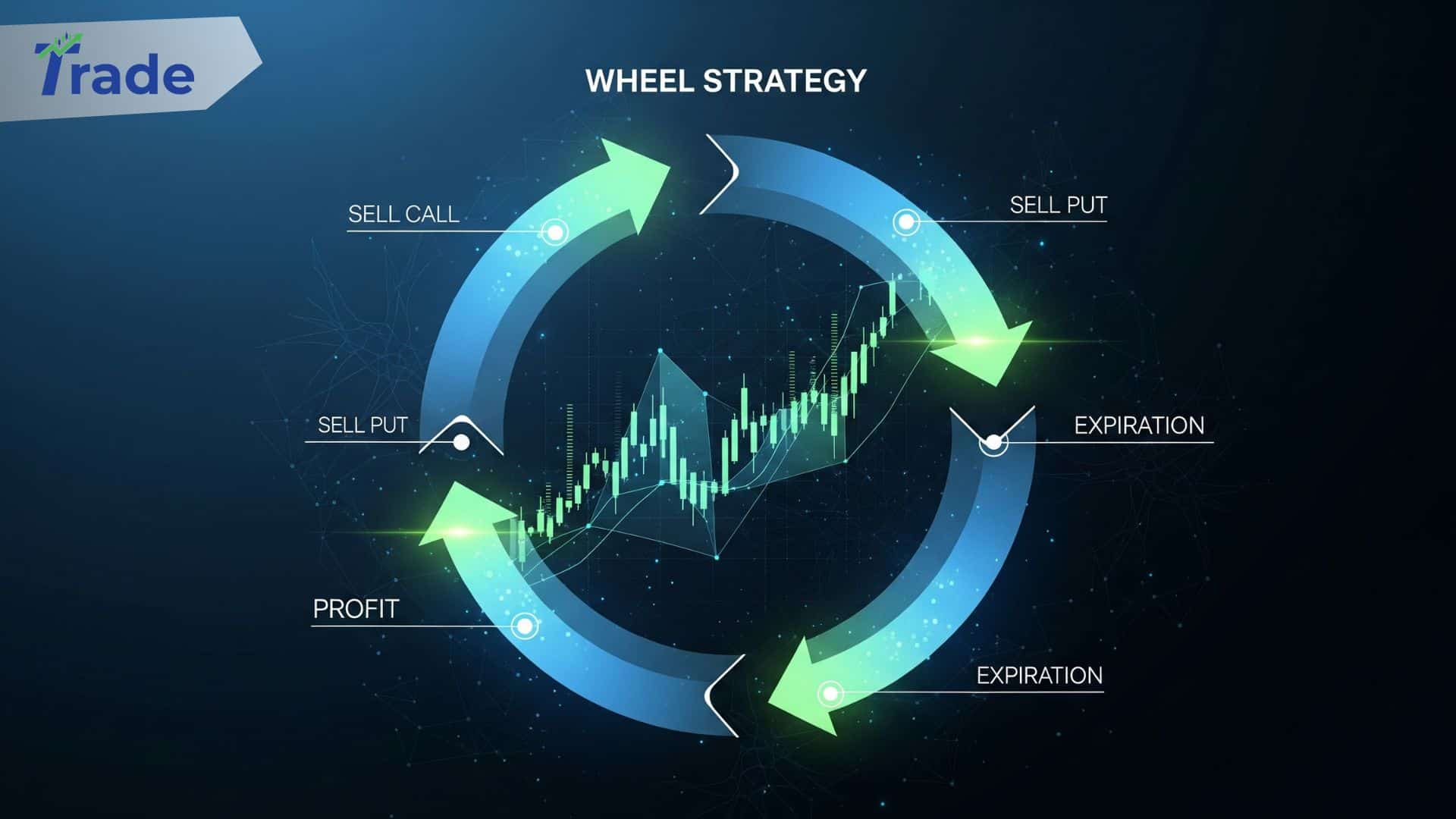
Key Takeaways
- The Wheel Strategy is a three-step cycle: sell puts, acquire stock (if assigned), and sell covered calls.
- Primary Goal: Generate recurring premium income while lowering the effective cost basis of stock ownership.
- Small Account Hack: Use NVDX (T-Rex 2x Long Nvidia) to wheel Nvidia with ~90% less capital than owning NVDA shares directly.
- Capital Requirement: Trading NVDA requires ~$18,000 USD; Trading NVDX requires only ~$1,750 USD.
- Risk Warning: NVDX is a leveraged ETF. It offers higher premiums but carries higher volatility and “volatility decay” risks compared to standard stocks.
Is it possible to get paid to buy a stock you already want?
Most investors buy stocks and hope they go up.
The Wheel Strategy takes a different route. It is a systematic options trading loop designed to generate cash flow regardless of whether the market is flat or rising slightly.
By combining Cash-Secured Puts and Covered Calls, you turn stock ownership into a rent-collecting asset rather than just a speculative bet.
This guide breaks down exactly how to execute the Wheel, the math behind the returns, and how Malaysian investors can use “Baby ETFs” to trade giants like Nvidia with a small account.
⚖️ At a Glance: The Wheel Strategy Workflow
| Stage | Action | Market Outlook | Goal |
| Step 1 | Sell Cash-Secured Put | Neutral / Slightly Bullish | Collect premium. Ideally, option expires worthless. |
| Step 2 | Assignment (If drops) | Bearish (Short term) | Buy 100 shares at a discount (Strike – Premium). |
| Step 3 | Sell Covered Call | Neutral / Slightly Bullish | Collect premium while holding stock. |
| Result | Stock Called Away | Bullish | Sell shares at a profit + keep premiums. Repeat Step 1. |
Step 1: Selling a Cash-Secured Put
The goal is to get paid for promising to buy a stock you like.
The cycle begins by selling (writing) a Cash-Secured Put. You are essentially acting as the insurance company: you collect a premium upfront in exchange for promising to buy 100 shares of a stock if it drops below a specific price (the Strike Price) by a specific date.
Choosing the Right Strike Price
- At-the-Money (ATM): Strike is near the current stock price. High premium, high chance of assignment.
- Out-of-the-Money (OTM): Strike is below the current price. Lower premium, but provides a “safety cushion.”
Step 2: Handling Assignment (Owning the Stock)
You are now a shareholder—but at a discount.
If the stock drops below your strike price, you are assigned and must buy 100 shares. Because you kept the premium from Step 1, your Cost Basis is lower than the market price.
Step 3: Selling a Covered Call
Rent out your shares while you wait for them to appreciate.
Now that you own 100 shares, you sell a Covered Call. You promise to sell your shares if the price rises to a certain level. In exchange, you collect another premium.
- Stock stays below strike: You keep the premium and the stock. Repeat.
- Stock rises above strike: Shares are sold (called away). You keep the cash + premium. Go back to Step 1.
Small Account Hack: NVDA vs. NVDX
How to Wheel Nvidia without RM 80,000 capital.
For many Malaysians, the biggest barrier to the Wheel Strategy is the “100 share” requirement. Options contracts represent 100 shares. To wheel Nvidia (NVDA) directly, you need massive capital.
The Solution: Use Leveraged ETFs.
You can use the T-Rex 2x Long Nvidia Daily Target ETF (NVDX). This is a “leveraged” ETF that aims to provide 200% of the daily return of Nvidia.2 Because of how it is structured, the share price is significantly lower, making it accessible for smaller portfolios.
NVDA vs. NVDX Capital Comparison
| Ticker | What is it? | Price (Approx) | Capital Needed for 1 Contract (100 Shares) |
| NVDA | Nvidia Corp (Main Stock) | ~$180 USD | $18,000 USD (~RM 80,000) ❌ |
| NVDX | T-Rex 2x Long Nvidia | ~$17.50 USD | $1,750 USD (~RM 7,800) ✅ |
By using NVDX, you can execute the Wheel Strategy on the AI boom with 1/10th of the capital.
Crucial Risk Warning: The “Volatility” Factor
While NVDX is cheaper, it is “High Octane.”
- Double Downside: If NVDA drops 5%, NVDX drops ~10%. You must be comfortable with wider price swings.
- Volatility Decay: Leveraged ETFs are designed for short-term trading. If NVDA stays flat for a year, NVDX might lose value due to management fees and the math of daily resetting.
- Strategy Fit: The Wheel on NVDX generates massive premiums (often 50%+ annualized IV), but you must be prepared to manage the position actively.
Real-World Example: Wheeling NVDX
Let’s look at the math for a small account (~$2,000 USD).
Imagine NVDX is trading at $17.50. You have $2,000 USD ready in your brokerage account (IBKR/Moomoo).
1. Selling the Put
You sell a $16.00 Strike Put (14 days out) and collect $0.60 premium ($60 total).
- Scenario A: NVDX stays > $16. You keep $60.
- $$Return = \frac{60}{1,600} = 3.75\%$$
in 2 weeks. (This is the power of leverage premiums).
- $$Return = \frac{60}{1,600} = 3.75\%$$
- Scenario B: NVDX drops to $15. You are assigned 100 shares at $16. Your net cost is $15.40.
2. Selling the Call
You now own 100 shares of NVDX. You sell a $17.00 Covered Call and collect $0.70 premium ($70 total).
- Scenario A: NVDX stays < $17. You keep $70 and the shares.
- Scenario B: NVDX rallies to $18. Shares called away at $17.
- Profit on Stock: $17.00 – $16.00 = $100
- Total Premiums: $60 (Put) + $70 (Call) = $130
- Total Profit: $230 USD on a ~$1,600 risk.
Pros and Cons of The Wheel Strategy
Is this strategy right for your portfolio?
| Pros (Why do it?) | Cons (What’s the risk?) |
| Consistent Income: Collect premiums weekly or monthly regardless of flat markets. | Limited Upside: If the stock “moons” (skyrockets), your gains are capped at the strike price. |
| Lower Entry Price: You buy stocks cheaper than the current market price. | Bag Holding: If the stock crashes, you are forced to buy it at the strike price. |
| Structured Discipline: Removes emotion by forcing you to buy low and sell high. | Leverage Risk (NVDX Specific): Using 2x ETFs amplifies losses during bear runs. |
Conclusion
The Wheel Strategy is a powerful tool for investors who want to move beyond simple “buy and hold” investing.
For Malaysian investors, NVDX offers a unique “cheat code” to trade the AI supercycle with a small account.
However, with great power comes great responsibility. The premiums on NVDX are juicy for a reason—the risk is higher.
Start with one contract, master the mechanics, and never trade with money you cannot afford to lock up for a few months.
Important Disclaimer: Pricing & Currency Risks
- Pricing Volatility: The prices mentioned (NVDX ~$17.65, NVDA ~$180) are based on market data as of December 2025. Stock prices are dynamic and can change instantly. Always check live quotes before trading.
- Currency Exchange Risk: All trades are settled in USD. For Malaysian investors, your actual return is affected by the USD/MYR exchange rate (currently approx. 4.12).
- If MYR strengthens (e.g., from 4.12 to 3.80), your USD profits will be worth less when converted back to Ringgit.
- If MYR weakens (e.g., from 4.12 to 4.50), your USD profits will be worth more in Ringgit.
- Educational Purpose Only: This article is for informational purposes and does not constitute financial advice. Options trading, especially with leveraged ETFs, involves significant risk of capital loss.
FAQs About The Wheel Strategy
How much capital do I need for NVDX?
NVDX trades around $17.50.3 You need cash to cover 100 shares, so approximately $1,750 USD (approx RM 7,800). This is significantly lower than the $18,000 needed for NVDA.
Is NVDX safe for long-term holding?
Generally, no. Leveraged ETFs suffer from “decay” over time. The Wheel Strategy helps mitigate this because you are constantly lowering your cost basis with premiums, but it is riskier than holding plain NVDA shares.
What happens if Nvidia crashes?
If NVDA crashes 20%, NVDX will crash roughly 40%. You will be assigned shares at a price much higher than the market value. You must be willing to hold through high volatility.
Can I do this on Moomoo or Rakuten Trade?
Yes, most Malaysian brokers with US access (Moomoo, Rakuten, Webull) allow options trading. Ensure you have “Options Trading Permissions” enabled in your account settings.
Why are NVDX premiums so high?
Premiums are based on “Implied Volatility” (IV). Since NVDX is 2x leveraged, it is twice as volatile as NVDA. Higher volatility = Higher risk = Higher premiums paid to you.