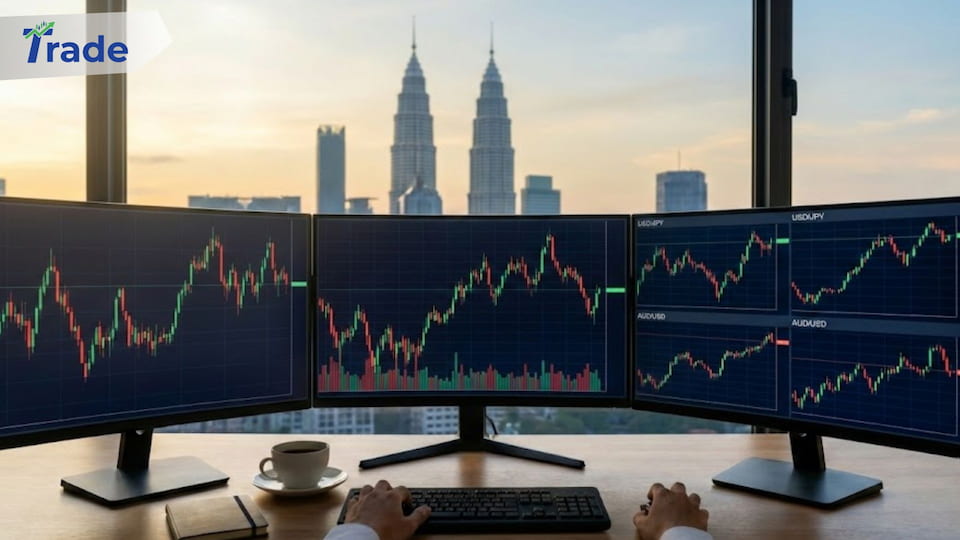
The Asia session is often dismissed as “too slow,” but for traders in Malaysia, it offers the perfect balance of consistency and lifestyle compatibility.
Trading doesn’t have to mean staring at charts at 3:00 AM. While the world chases the chaos of the New York open, the Asia session (Tokyo/Sydney) provides a structured, predictable environment that happens right during our normal business hours.
If you understand how to navigate lower volatility, this session becomes a reliable income stream rather than a stressful gamble. This guide breaks down exactly how to adapt your strategy for the Asian market—turning its “slowness” into your edge.
Session Comparison: Asia vs. The World
This breakdown highlights why you shouldn’t trade the Tokyo open the same way you trade New York.
| Feature | Asia Session (Tokyo/Sydney) | London/New York Sessions |
| Best For | Range Trading & Reversions | Trend Following & Breakouts |
| Primary Volatility | Low to Medium | High to Extreme |
| Key Pairs | USD/JPY, AUD/USD, NZD/USD | EUR/USD, GBP/USD, Gold (XAU) |
| Market Behavior | Respects support/resistance levels | Frequently breaks levels |
| Risk Profile | Lower slippage, slower moves | High slippage, fast reversals |
| Ideal Trader | Patient, systematic, risk-averse | Aggressive, news-reactive |
Why Trade the Asia Session in 2026?
Trading during local daylight hours allows for better decision-making and sustainable routine building.
For Malaysians, the Asia session is simply practical. You aren’t fighting biology by staying awake all night. The market opens early in the morning (Sydney) and picks up when Tokyo comes online (typically 8:00 AM local time).
This alignment means you can treat trading like a standard business operation, managing positions while the sun is up. Unlike the erratic spikes seen during US news releases, the Asian market tends to move methodically. This creates a safer environment for beginners or those managing larger capital who prefer to avoid the “whipsaw” effect of high-impact news events.
Which Currency Pairs Should You Focus On?
Liquidity during the Asian session is concentrated in the currencies of the region: the Yen, Aussie Dollar, and Kiwi.
Attempting to trade EUR/GBP or other cross-pairs during this time is usually a mistake. The spreads are wide, and the movement is practically non-existent. To make money here, you must go where the money is actually flowing.
Top 3 Pairs for Malaysian Traders:
- USD/JPY: The king of the Asia session. It has the most volume and reacts logically to technical levels.
- AUD/USD: Heavily influenced by Chinese economic data and Australian market opens.
- AUD/JPY: A strong cross-pair that combines the volatility of both major regional economies.
Note: If you trade Gold (XAU/USD), be aware that it often consolidates during these hours. It is a poor choice for trend traders but excellent for scalpers looking for quick $2-$3 moves.
The 5 Golden Rules of Asia Session Trading
Before you place a single trade, cross-check these non-negotiables. This session punishes impatience but rewards precision.
1. Never Chase the Breakout
In the London session, a candle closing outside a box often means “Go.” In Asia, it usually means “Trap.” Market makers often push price 5–10 pips above a high just to trigger stop-losses before reversing. Rule: If it breaks out, wait. If it falls back in, then you enter.
2. Define Your Box by 9:00 AM
The first hour of the Tokyo open (8:00 AM – 9:00 AM Malaysia time) sets the “Initial Balance.” Draw horizontal lines at the high and low of this first hour. This is your battlefield. You only trade when price interacts with these lines.
3. Stick to the “Home Team” Pairs
Don’t trade EUR/GBP or USD/CAD now. The banks in Europe and Canada are closed. Volume is dead, and spreads are wide. Rule: Only trade pairs containing JPY, AUD, or NZD. This ensures you have enough liquidity to actually get in and out of trades cheaply.
4. Target the Center, Not the Moon
Volatility is low. If you buy at the bottom of the range, don’t hold for a new high. Rule: Take profit at the 50% mark (mid-range) or the opposing level. Trying to squeeze an extra 10 pips in this session often turns a winner into a loser.
5. Kill All Trades by 2:00 PM
The “London Approach” begins around 2:00 PM – 3:00 PM Malaysia time. Pre-London volume starts flowing in, and the “Range Rules” stop working. Rule: Close all Asia session positions before Europe wakes up to avoid getting run over by a volatility spike.
Strategic Setup: The “Liquidity Sweep & Fade”
This is the bread-and-butter setup for 2026. We are not guessing; we are waiting for the market to show its hand.
Most retail traders put their Stop Loss just above the recent high. Smart Money knows this. They will push the price up through that high to trigger those stops (Liquidity Sweep) and then immediately sell it down.
The Step-by-Step Execution:
- Identify the Range: Mark the High and Low of the price action between 6:00 AM and 9:00 AM (MYT).
- Wait for the Poke: Watch for price to push through the top resistance line.
- Watch the Clock: Is it between 9:00 AM and 11:00 AM? This is prime time.
- Confirm the Fake: Does the candle leave a long wick and close back inside the range? That is your signal.
- Enter the Fade: Sell immediately when the candle closes back inside.
- Stop Loss: Place it 5–10 pips above the “wick” high.
- Take Profit: The middle of the range (safer) or the bottom of the range (aggressive).
Risk Management for Low Volatility
Just because the market is slow doesn’t mean you can’t lose money. In fact, “boredom” is the biggest account killer here.
- Spread Awareness: Since volatility is lower, the “cost of business” (spread) matters more. If you are targeting 15 pips, a 2-pip spread eats 13% of your profit. Ensure you are using a “Raw Spread” or ECN broker account.
- Smaller Stops, Larger Size? Some advanced traders use tighter stops (10 pips) in Asia because the random noise is lower, allowing them to slightly increase lot size while keeping risk dollars the same. Only do this once you are consistently profitable.
- The “News” Trap: Check the calendar for “Red Folder” events from the Bank of Japan (BoJ) or RBA (Australia). If there is a speech or rate decision, DO NOT use the range strategy. Volatility will spike, and the range will break.
The Asia Session “Range Fade” Cheat Sheet (GMT+8)
Copy this checklist and keep it on your desk.
1. The Setup Phase (7:00 AM – 9:00 AM)
- [ ] Open charts. Check Forex Factory for AUD/JPY/CNY “Red Folder” news.
- [ ] If High Impact News is scheduled: NO TRADE until 30 mins after release.
- [ ] Select Pairs: USD/JPY, AUD/USD, AUD/JPY only.
- [ ] Draw the “Box”: Mark the High and Low of the price action from 7:00 AM to 9:00 AM.
2. The Trap Phase (9:00 AM – 12:00 PM)
- [ ] Wait: Do nothing until price touches the top or bottom line.
- [ ] Observe: Did price break the line?
- If Yes: Watch for a rejection wick.
- If No: Wait longer.
- [ ] The Signal: Price breaks the line but closes back inside the box (The Fakeout).
3. The Execution
- [ ] Entry: Market Order immediately on the close back inside.
- [ ] Stop Loss: 5-8 pips above/below the wick of the fakeout candle.
- [ ] Take Profit 1: 50% of the range (Secure the bag).
- [ ] Take Profit 2: The opposite side of the box.
4. The Exit Rules
- [ ] If trade is open at 2:00 PM: CLOSE MANUALLY. Do not hold into London Open.
- [ ] If price stalls in the middle for >1 hour: CLOSE. Momentum is dead.
“I am a sniper, not a machine gunner. I wait for the trap, or I do not shoot.”
Conclusion: Profit from Patience
The Asia session rewards patience over aggression. For Malaysian traders, it offers a unique opportunity to trade a calmer, more technical market during reasonable hours. By focusing on JPY and AUD pairs and adopting a range-bound mindset, you can build a sustainable trading business without the burnout of the night shift.
Stop trying to force 100-pip moves where they don’t exist. Respect the range, take the small wins, and let the compound effect do the heavy lifting.
FAQs About Asia Session Forex Trading Strategies
What time does the Asia session start in Malaysia?
The session effectively kicks off with the Sydney open at roughly 5:00 AM or 6:00 AM (depending on DST), but volume truly enters when Tokyo opens around 8:00 AM Malaysia time.
Is the Asia session good for beginners?
Yes, it is often safer for beginners because the market moves slower, giving you more time to analyze charts and make decisions without panic.
Can I trade GBP/USD during the Asia session?
You can, but it is not recommended. The volatility is very low, and spreads are often higher because London banks are closed.
Do news events affect the Asia session?
Yes, but they are specific to the region. Watch out for interest rate decisions from the Bank of Japan (BoJ) or the Reserve Bank of Australia (RBA).
Why do my breakout trades fail in the morning?
Breakouts require volume. The Asian session lacks the massive institutional volume of London/New York, so “breaks” often lack the power to sustain a trend, resulting in reversals.