Key Takeaways
- Profitability is a behavior problem, not a chart problem: If you have a strategy but no profits, the variable is you.
- Systems replace willpower: A rigid “If/Then” mechanical system removes the emotional decision fatigue that leads to tilt.
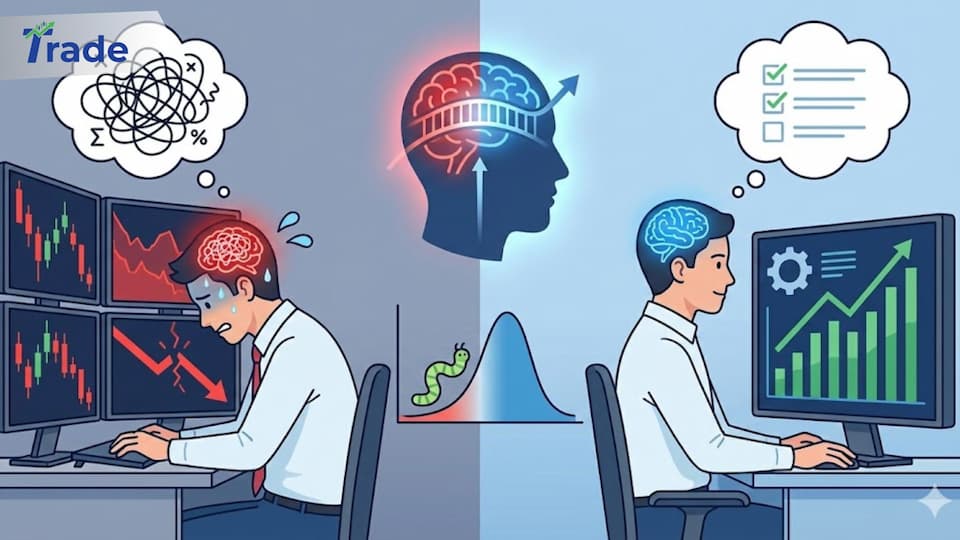
- The “Inchworm Concept”: You cannot improve your potential (A-Game) until you stop your worst habits (C-Game) from leaking capital.
- Emotions are data: Fear and hesitation are not random; they are signals that your system has a gap or you don’t trust it yet.
- The “Casino Mindset”: The house doesn’t panic when a player wins a hand because the math guarantees victory over time. Be the house.
It’s 4:55 PM. The charts are moving, your heart rate is up, and you just closed a trade early because you “felt” it reversing. Ten minutes later, it hits your original Take Profit.
If you run a business, you rely on SOPs (Standard Operating Procedures). You don’t make up the rules based on how you feel that morning. Yet, in trading, you likely abandon your SOP the moment money is on the line.
You have the strategy. You have the charts. But the account isn’t growing. This isn’t a technical failure—it’s a System and Mindset Execution Gap.
The Amateur vs. The System Trader
The gap between you and a profitable trader isn’t a “secret indicator.” It is the presence of a mechanical system that prohibits emotional interference.
| Feature | The Discretionary Trader (Amateur) | The System Trader (Pro) | Action Step |
| Decision Making | Based on “feel,” intuition, or fear of missing out (FOMO). | Based strictly on “If X happens, do Y.” No thinking required. | Write down your “If/Then” rules today. |
| Reaction to Loss | Takes it personally; tries to “win it back” (Revenge Trading). | Views it as a “business expense” (Cost of Goods Sold). | Accept that losses are part of the winning probability. |
| Confidence | Fluctuates with the last trade result. | Rooted in backtested data over 100+ trades. | Backtest your system until you trust the math, not the candle. |
| Risk Management | Varies size based on how “good” the setup looks. | Fixed risk % (e.g., 1%) regardless of the setup. | Remove the “lot size” decision; make it static. |
| Focus | Obsessed with predicting where price will go. | Obsessed with executing the rules perfectly. | Grade yourself on execution, not P&L. |
Is It Your Strategy or Your Psychology?
Most traders spend years jumping from strategy to strategy (the “Cycle of Doom”). But if you hand a winning strategy to a losing trader, they will still lose money. Why? Because they lack the mental framework to execute it during a drawdown.
The Reality Check:
Jared Tendler, a leading trading psychology coach, argues that emotions are not “problems” to be suppressed—they are signals.
- Fear usually means you are risking too much or don’t trust your backtest.
- Greed (moving TP) means you don’t have a defined exit rule.
- Anger means you believe the market “owes” you a win.
If you don’t have a mechanical system, every candle forces you to make a decision. That uses up “mental capital.” Eventually, your willpower snaps, and you tilt.
Why Do I Keep Repeating the Same Mistakes?
You promise yourself you won’t move your Stop Loss. Then you do it anyway. This happens because of the Inchworm Concept.
Imagine your trading performance as a bell curve.
- A-Game: Your best days (perfect discipline).
- C-Game: Your worst days (over-leveraging, revenge trading).
You are likely obsessed with improving your A-Game (learning new concepts). But your profitability is defined by your C-Game. If your C-Game involves blowing 20% of your account in one bad afternoon, no amount of “winning knowledge” can save you.
The Fix:
Stop trying to make more money. Focus entirely on losing less. You must create a system rule that physically prevents your C-Game (e.g., a daily loss limit that locks your platform).
The “Casino Mindset”: Thinking in Probabilities
The video “Trading is hard until you build systems” highlights a crucial truth: You cannot predict the outcome of ONE trade. You can only predict the outcome of 100 trades.
Casinos make billions because they don’t care about a single hand of Blackjack. They know that over 1,000 hands, the statistical edge (mathematics) guarantees they win.
How to Apply This:
- Stop judging your success by today’s P&L.
- Judge your success by: “Did I follow my system perfectly?”
- If you followed your rules and lost money, that is a Good Loss.
- If you broke your rules and made money, that is a Bad Win (because it reinforces bad habits).
How to Build the “Mental Hand History”
To fix the mindset, you need to debug your brain like you debug a computer code. Tendler suggests the Mental Hand History.
The 5-Step Process to Fix a Mental Leak:
- Identify the Trigger: “I felt an urge to close the trade early when price stalled.”
- Describe the Flaw: “I was afraid the profit would turn into a loss.”
- The Root Cause: “I am focusing on the money (P&L) rather than the technical market structure. I don’t trust my backtesting data.”
- The Logic Correction: “One trade does not matter. My edge plays out over a series of trades. If I intervene, I ruin the probability.”
- The New Rule: “I am not allowed to touch an open trade. I either hit Stop Loss or Take Profit. No exceptions.”
Conclusion
Trading is simple, but it isn’t easy. The difficulty lies in doing the boring thing over and over again while your emotions scream at you to “do something.”
For Malaysian SMEs and traders, treat this like your business. You wouldn’t let your emotions dictate your inventory prices, so don’t let them dictate your entries. Build the system. Trust the math. Let the probability do the work for you.
Stop trying to be a “good trader.” Start being a “good executor” of your system.
FAQs About Trading Mindset & Systems
How do I stop “Revenge Trading” after a loss?
Set a hard “Daily Loss Limit” (e.g., 2% of equity). If you hit it, walk away. Physically leave the computer. The market will be there tomorrow; your capital might not be.
My system works in backtesting but fails in live trading. Why?
This is “Execution Slippage.” In backtesting, you don’t feel fear. In live trading, fear causes you to enter late or exit early. You must reduce your risk size until the fear disappears.
Can I trade without emotions completely?
No. You are human. The goal isn’t to feel nothing; it is to have a system so rigid that your feelings cannot change your actions.
How many trades do I need to trust a system?
You need a sample size of at least 20–30 trades to see if a system has an edge. Judging it after 3 losses is a statistical error.
What is the biggest mindset red flag?
“Hope.” If you are in a trade and you start hoping it turns around, you have already lost. You are no longer trading; you are gambling.
Should I read “Trading in the Zone”?
Yes. Mark Douglas’s concept of thinking in probabilities (the “Casino Mindset”) is the foundation of all profitable system trading.